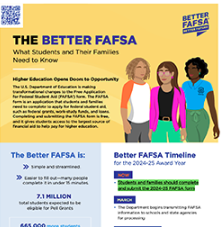
The U.S. Department of Education is making transformational changes to the Free Application for Federal Student Aid (FAFSA®) form. The FAFSA form is an application that students and families need to complete to apply for federal student aid, such as federal grants, work-study funds, and loans. Completing and submitting the FAFSA form is free, and it gives students access to the largest source of financial aid to help pay for higher education.
The Better FAFSA is simplified, redesigned, and streamlined. It is faster and easier to fill out, with most students and families completing it in less than 15 minutes. It ensures 665,000 more students will receive Federal Pell Grants to pay for college. Additionally, more than 1.7 million more students will receive the maximum Pell Grant.
The Department is pleased to share some of the significant progress that has been made with the help of our partners and improvements we are making for the 2025–26 FAFSA cycle. The Department is committed to learning from challenges with the launch of the 2024–25 FAFSA form, increasing transparency, and making key improvements to the experience for students, families, colleges, and other stakeholders in the coming year. Read more here.
Some students who already submitted FAFSA forms may need to make corrections. For students who need to make corrections to their FAFSA form, doing so should only take a few minutes. To get started, students and contributors should go to their StudentAid.gov account and select the form that notes an "Action Required" under "My Activity." Select "View FAFSA Submission Summary" to review the information and any actions you need to take to complete the form. Select the "Make a Correction" button at the top of the "FAFSA Form Answers" tab. Some of the most common corrections include signing the form or providing consent and approval to access and use federal tax data. Remember: successfully completing your FAFSA form is the first step to unlocking affordable and accessible higher education opportunities.
Watch these videos to learn more about making corrections to your FAFSA:
Other useful resources to help you prepare and submit your FAFSA® Form:
The IRS provides tax benefits for education. They can be used on tuition or loan interest or to maximize your college savings.
A list of Federal Student Aid servicers for the Direct Loan Program and for FFEL Program Loans purchased by the U.S. Department of Education is available on our Loan Servicer page.
For more information about student loan interest deduction, visit the IRS's Tax Benefits for Education: Information Center.
The 1098-T, Tuition Statement form reports tuition expenses you paid for college tuition that might entitle you to an adjustment to income or a tax credit. Information on the 1098-T is available from the IRS at Form 1098-T, Tuition Statement.
| State | Rate as of 12/20/24 |
|---|---|
| Puerto Rico | 96.30% |
| District Of Columbia | 76.70% |
| Tennessee | 72.80% |
| Louisiana | 71.30% |
| Mississippi | 70.30% |
| Illinois | 69.70% |
| California | 69.40% |
| Rhode Island | 68.10% |
| Connecticut | 66.30% |
| Delaware | 65.70 |
The submission rate is based on the number of high school senior 2024-25 FAFSA submissions divided by the projected total of high school graduates for that state.
Check out high school FAFSA submission rates by state here (updated 12/18/24)
On May 6, the Department launched the FAFSA Student Support Strategy to continue increasing the number of high school students who complete a 2024-25 FAFSA and enroll in college, particularly first-time college students and students of color. This investment builds on the Department's efforts to help students, families, and institutions through the 2024-25 FAFSA application cycle, in addition to the College Support Strategy, the FAFSA Fast Break campaign, and direct communication efforts with institutions and stakeholders via the FAFSA Fast News blog.
As part of the FAFSA Student Support Strategy, the Department is providing up to $50 million to help school districts, states, nonprofits, and other public and private organizations with efforts to boost FAFSA completion. These funds will help grow capacity for organizations supporting FAFSA completion efforts, facilitate FAFSA clinics, and provide transportation and communication supports to families as needed. The program will be implemented by ECMC to support organizations with demonstrated experience expanding college access and enrollment. For additional details, read the press release here.
Thanks to the overhauled FAFSA form, the majority of income data now comes directly from the IRS, which will not need to be verified. This year's reduction in verifications will reduce the burden for colleges and students while continuing to protect against fraud.
The Department will, through Sept. 2024, waive the requirement for institutions to recertify eligibility for federal student aid programs no later than 90 days before their Program Participation Requirement expires. This flexibility will give time back to institutions at this critical moment.
The Department is posting new data and resources to help schools drive FAFSA completion. For example, the Department released data by high school on their students' 2024 — 2025 FAFSA submissions, two months ahead of schedule.
The Department suspended new reviews through September 2024, except for the most serious issues, helping colleges focus on getting aid award offers to students.